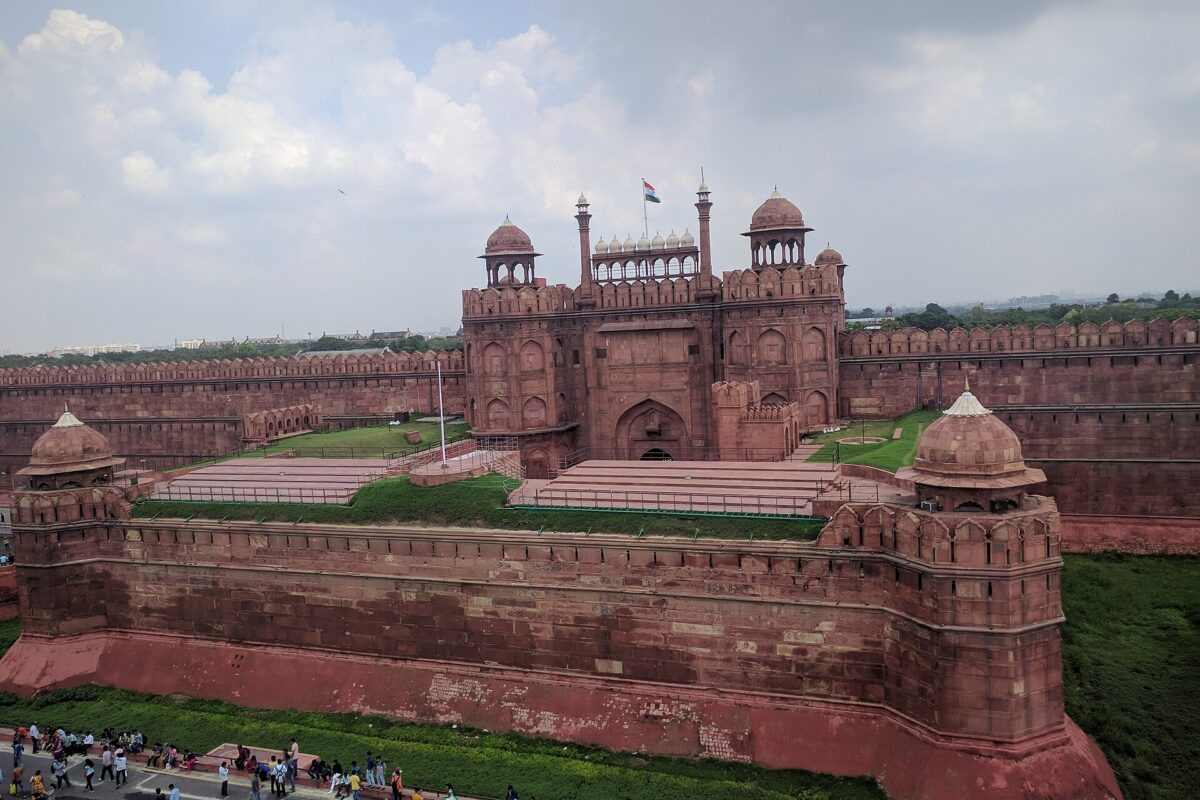
For two centuries the Red Fort was the centre of the Mughal empire, and since 1947 it has been where India’s Prime Minister raises the flag on Independence Day. Behind its long red sandstone walls is a sequence of palaces, pavilions and gardens that still make sense of how an imperial court lived.
A little history
Shah Jahan moved his capital from Agra to Delhi and built the fort as the citadel of his new city, Shahjahanabad; it was completed in 1648. After the uprising of 1857 the British removed many of its buildings and used it as a garrison. The Red Fort Complex was inscribed as a UNESCO World Heritage Site in 2007.
What to see inside
- Lahori Gate and Chhatta Chowk — the main entrance and the covered bazaar that once sold silks and jewellery to the court.
- Diwan-i-Aam — the Hall of Public Audience, where the emperor sat on a marble canopy to hear petitions.
- Diwan-i-Khas — the Hall of Private Audience, once home to the Peacock Throne, with the famous Persian couplet about paradise on earth.
- Rang Mahal and Khas Mahal — the private apartments along the river side.
- The museums — several galleries in the fort cover the Mughal period and India’s freedom struggle.
The evening show
A sound-and-light show runs in the evenings in Hindi and English, retelling the fort’s history. It is ticketed separately; check the current schedule and book before you go.
Good to know
The fort is closed on Mondays. Book tickets online, as weekend queues can be long. Security is strict; carry only a small bag. Pair the visit with lunch in Chandni Chowk.