Most people come to Mehrauli for the Qutub Minar, take their photos and leave. A few hundred metres away, Mehrauli Archaeological Park holds dozens of monuments from several centuries, spread across paths through scrub forest. There is no ticket, few signs and, on a weekday morning, hardly anyone else.
Rajon ki Baoli
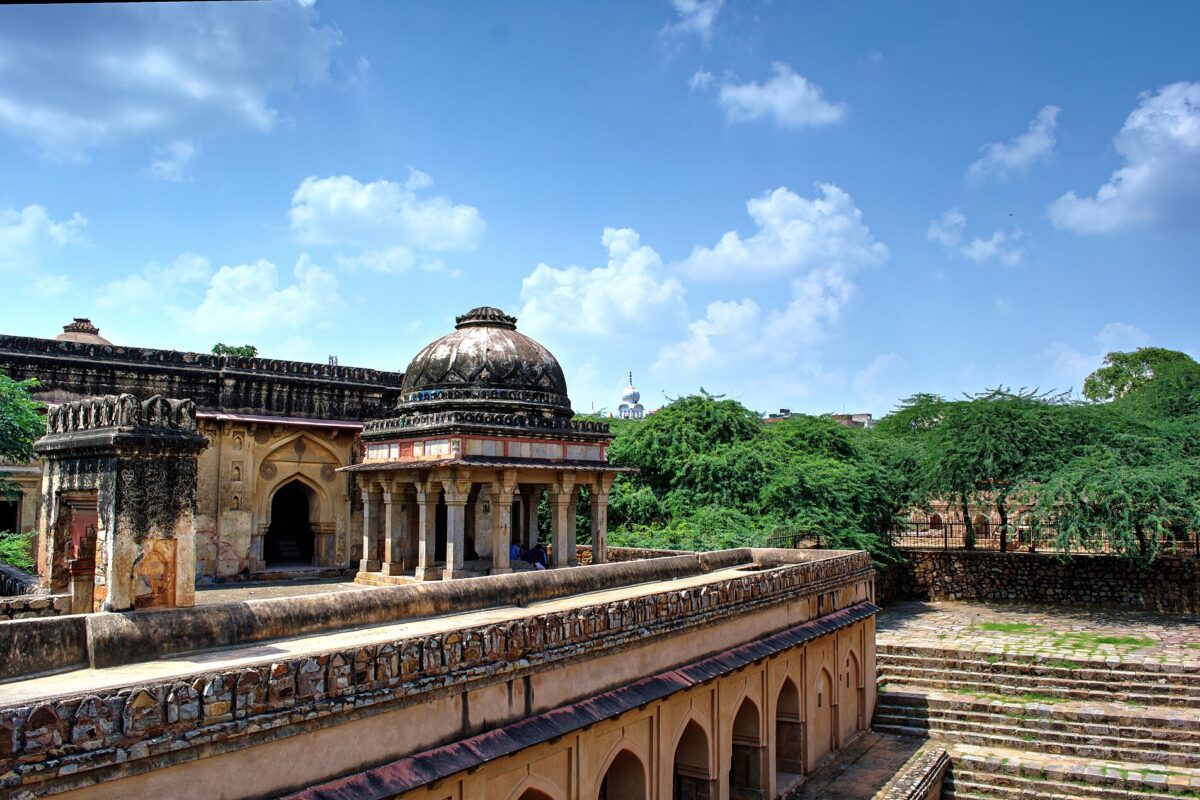
The park’s best-known monument is Rajon ki Baoli, a stepwell from the Lodi period in the early 16th century. Several storeys of arched colonnades descend towards a pool of water. The name is usually explained as the stepwell of the masons (raj), who are said to have used it. It is the most photographed spot in the park, and still quiet by city standards.
Jamali Kamali
The mosque and tomb of Jamali Kamali date to the early 16th century. Jamali was a Sufi poet at the courts of the Lodis and of Babur; the identity of Kamali, buried beside him, is uncertain. The mosque is a fine example of the transition towards Mughal architecture. The tomb chamber has a painted and plastered ceiling, but it is often locked — if it is open, it is worth the detour.
Balban’s tomb and more
- Balban’s tomb — the ruined tomb of the 13th-century Sultan Balban, often cited as one of the earliest examples of a true arch in India.
- Quli Khan’s tomb — an octagonal Mughal-era tomb that the British official Thomas Metcalfe later converted into a weekend retreat he called Dilkusha.
- Gandhak ki Baoli — another stepwell, just outside the park near Mehrauli village.
Tips for visiting
- Go in the morning. The park is shaded but gets hot by midday for much of the year.
- Paths are uneven and unlit; plan to leave well before dusk and preferably visit with company.
- Carry water and snacks — there are no shops inside.
- Download an offline map. Signage is limited and it is easy to walk in circles.