Stand at the foot of the Qutub Minar and you are looking at more than one reign’s ambition. The 72.5-metre tower in Mehrauli was begun around the turn of the 13th century and finished over the next 170 years by three different rulers — which is why its five storeys don’t quite match.
How the tower was built
Qutb-ud-din Aibak, the first ruler of the Delhi Sultanate, laid the foundation and completed only the first storey. His successor and son-in-law Iltutmish added the next three. After lightning damaged the top in the 14th century, Firoz Shah Tughlaq rebuilt it, adding the storeys faced with white marble that you can see near the summit. Look closely and the change in stone and style between the lower red sandstone tiers and the upper levels is easy to spot.
The minar’s bands of carved calligraphy record its builders and verses from the Quran. The interior staircase of 379 steps has been closed to visitors for decades, so the view is from the ground — which, with the right light, is the better one anyway.
What to see beyond the minar
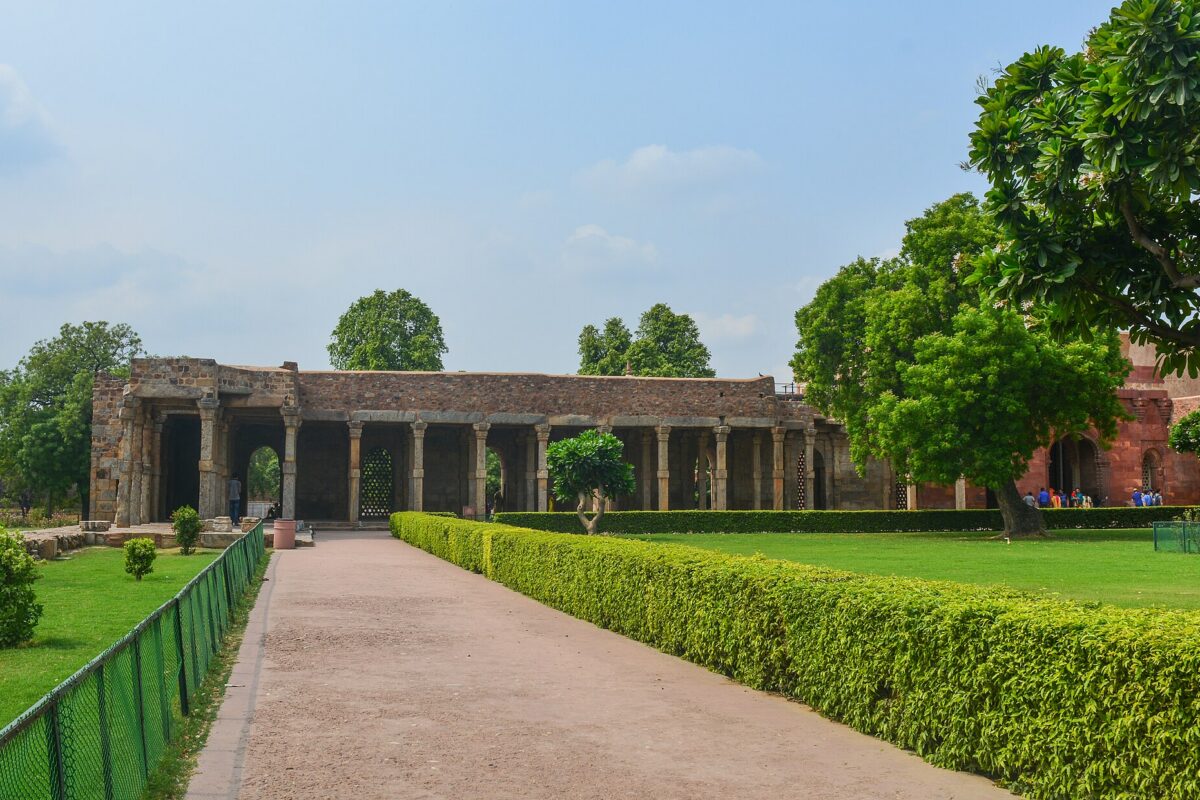
- Quwwat-ul-Islam mosque — among the earliest mosques built in Delhi. An inscription records that it used material from earlier temples; carved Hindu and Jain pillars are still visible in its colonnades.
- The Iron Pillar — dated to the Gupta period, around 1,600 years old, and famous for how little it has rusted. It is now fenced, so the old custom of trying to wrap your arms around it is no longer possible.
- Alai Darwaza — the domed southern gateway built by Alauddin Khalji in 1311, with some of the finest early Indo-Islamic ornament in Delhi.
- Alai Minar — the stump of a tower Alauddin Khalji meant to be twice the height of the Qutub Minar. Work stopped after his death.
- Iltutmish’s tomb — a roofless chamber with richly carved interior walls, easy to miss behind the mosque.
Planning your visit
Arrive at opening time. Before about 10 am the complex is quiet and the low sun brings out the texture of the carving. Winter mornings can be hazy, so if photography matters, late afternoon is a good alternative. Buying your ticket online through the ASI portal saves time at the counter; keep an ID handy.
Wear comfortable shoes — the lawns and stone paths add up — and carry water, as there are only basic stalls inside. Plan two to three hours if you want to read the information boards and see the smaller structures.
Combine it with Mehrauli
The Qutb complex sits at the edge of Mehrauli, one of Delhi’s oldest continuously inhabited areas. Next door, the Mehrauli Archaeological Park has stepwells and tombs scattered through woodland and is free to enter — a good way to spend the rest of the morning.